
The Rule of Law Is the Core Technology
The Rule of Law Is the Core Technology
By Sheng Hong
The United States' charges against Meng Wanzhou and against Huawei as a whole are a major blow to the company. But their nature should not be exaggerated. Some say, for instance, that this is a Sino-American "technology war"—that because Americans are unwilling to see China surpass the US in high technology, they are striking at China's most accomplished high-tech enterprise, Huawei. Think it over carefully: if all these "crimes" of Huawei's held up, the most serious consequence would be a ban on selling Huawei products in the US and some of its allies—but this would not prevent Huawei from selling in China, the world's largest market, and in other countries. To say this would cut off Huawei's path to research and development is even more far-fetched. Was Huawei's technology really stolen from America? Can one build a world-leading enterprise by "stealing"? Conversely, to suppose the Americans' aim is to suppress China's high-tech development by suppressing Huawei seems equally absurd, for it assumes the Americans also believe one can become a world-leading technological power by stealing technology. Had Americans truly believed this, there would be no American technology as it is today; and if the Chinese believe the Americans believe this, then China's hope of catching up is indeed lost.
That the development of science and technology does not rely on stealing is quite clear. For to steal there must be something to steal—namely, the original. The original, then, is better than the stolen, and the method of creating the original is better than the method of stealing. Original science and technology can develop because they rely on an environment for growth. This refers mainly to the institutional environment. For a society, this includes a university and research system of free inquiry, fair debate, and open exchange; it includes a system for sharing and disseminating public knowledge; and it includes an intellectual-property system. For an enterprise, it means building a research-and-development team within such an institutional environment—a team that Commons called a "going concern." Of this concept I wrote, in an article titled "Intel's Success and the Going Concern," that "it seems more apt to use it to describe an organization that ceaselessly 'produces' knowledge… The production of knowledge manifests as a dynamic tradition, like a river that flows on day and night without cease."
If the team producing knowledge and its mechanism are a great river, then "relative to this ceaselessly flowing tradition, any so-called knowledge product—whether an academic work, a drug formula, software source code, or a computer microprocessor—is no more than a cross-section of a frozen river; any innovative individual is no more than a spray of foam in this river; and the process of producing knowledge is no more than a by-product of the river's existence, rather like a ditch dug beside a great river." If one steals technology, one can steal only this most terminal thing, but cannot carry off the "going concern" and its research capacity—which not only fails to form one's own R&D team and mechanism but can never move ahead, because what can be stolen is necessarily already-materialized invention, already obsolete. The individuals in such a team are not so important either; even the most brilliant, if they leave the team and mechanism, find their knowledge lacking the other knowledge that complements and reinforces it, and their probability of success falls.
So among enterprises, and among nations, competition in science and technology must ultimately rely on competition in institutions. That being so, the most important thing for an enterprise or a nation is to cultivate "inner strength"—the building and improvement of its own institutional environment and research organization. With that, external suppression is not worth mentioning. The question is: is Huawei such an enterprise? Is China such a nation? If so, then when the US government says Huawei and other Chinese enterprises developed mainly by stealing technology, is that not slander? It must be said the matter is fairly complex. Since reform and opening, China has opened comprehensively in the realms of thought, scholarship, and culture, built a system of universities and research institutions free of political interference, and gradually built an intellectual-property system as well. This has provided a preliminary institutional framework for our country's "production" of knowledge—both public knowledge and institutionally protected knowledge—and is the main driver of our technological development. In 2017, China ranked first in the world in patent applications, at 40 percent of the global total. Huawei developed within just such a broad environment. That year its number of invention-patent grants ranked second in China, as high as 3,293. Where it excelled other Chinese enterprises was that Huawei created its own excellent R&D team—a "going concern," with its own rules, traditions, and personnel—and could thus bring forth new technology in an endless stream.
Yet even as the new institutional framework for the "production" of knowledge took shape, our country's old institutions did not withdraw. Through fiscal means they redistribute the wealth pouring forth from the market, transferring large sums that should have been used in the market to non-marketized uses. This is our country's system for allocating scientific-research funds. Basic research, by its nature, produces public knowledge and needs a certain degree of state funding; countries the world over have similar mechanisms. The European nations founded national academies of science in the seventeenth and eighteenth centuries, and countries such as the US now have a National Science Foundation. Then there is applied research with strong externalities, which sometimes also needs state funding—the British Parliament, for instance, once offered a prize for a technique to determine longitude, and the internet grew out of a US military network. The problem is that our country's research-fund allocation system is not only enormous in scale—more than 800 billion yuan a year (compared with about 200 billion yuan for the US)—but also misdirected: only 11.6 percent of China's national research funds go to basic research (2017, estimated from Ministry of Science and Technology data), whereas 90 percent of the US federal government's national research funds go to the National Science Foundation.
Even the portion used for basic research has a relatively low input-output efficiency, for want of a good mechanism of discernment and review. Because the allocation of such enormous sums rests not on academic rules, market rules, or the intellectual-property system, but on the allocation rules of administrative agencies. The procedure is that research organizations or individuals apply, and a review committee decides. Since the power of the authorities administering the funds lacks constraint, the review committees are mostly for show, and mutually competing research organizations and individuals obtain funds not by the superiority of their research projects alone but more by their resources in officialdom. Professor Rao Yi of Peking University and Professor Shi Yigong of Tsinghua University criticized that "doing good research matters less than cultivating relationships with officials and the experts they favor." A researcher who analyzed the state of university research in China concluded that, on the whole, "the research performance of universities is less than ideal—only 38.7 percent of regions reached the optimal state, while most of the rest were in a stage of diminishing returns to scale" (Zhong Jie and Chen Jingyi, "An Empirical Study of Input-Output Efficiency of University Research Journals," China Science and Technology Resources Review, December).
On the surface, China's number of papers already surpassed America's in 2016, ranking first in the world. But Professor Shi Yigong warned that too many of China's papers are "garbage." The reason is that our country's research system relies on government funding and uses quantitative indicators as its evaluation standard. As Professor Steven Cheung put it in his "law of performance," once the unit of measurement for pricing is fixed, the seller will strive to fulfill the requirement of that unit while neglecting other aspects. If diamonds are priced only by carat, for instance, the seller will not value color, cut, or flaws. If heroes are judged only by the number of papers, quality is bound to suffer. The evaluation system can of course further grade by a journal's "impact factor," but this is merely another "pricing standard," and a new round of the "performance law" effect appears: not only can China's many academic journals cite one another to raise their "impact factor," but international journals are corrupted thereby too. Since publishing papers in international academic journals is an evaluation standard—bringing bonuses, aiding title evaluation, and helping secure research funds—setting one's sights on international journals is the natural result.
Mu Yunqiu and Jiang Xiaoyuan point out that the recently risen "open access" trend in academic journals is, in essence, profit-seeking in scholarship's name. Though it cannot be wholly dismissed, combined with China's research system it forms a cycle of "willing to strike, willing to be struck." Under this trend, famous international journals such as Nature, Scientific Data, Scientific Reports, The Lancet, and Cell have all launched "open access" sub-journals to draw in the silver of low-end papers, at up to 5,000 US dollars apiece. And the largest source of funds is China. It is estimated that "in 2017 Chinese authors published a total of 69,051 open-access papers… contributing about 760 million yuan in total fees." They note that the proportion of Chinese papers in the "notorious Tumor Biology reached 65.5 percent, in Oncotarget 80.3 percent"—American journals tailor-made for Chinese authors.
If the effect of national research funds used for basic research is less than ideal, then that of funds used for commercial purposes is worse still. This is because basic research inherently has theoretical vagueness and uncertainty, and the merits of a research plan are harder to judge in advance; whereas commercial research has fairly clear aims and is easily evaluated from a market standpoint—but if allocation is still made chiefly by power and connections, it deviates even further from the optimal. By National Bureau of Statistics data, in 2017 the government research funds of our country's research institutions were about 202.6 billion yuan, 83 percent of their total expenditure; those of universities about 80.5 billion, 63 percent. Because most of the government funds—82 percent at research institutions and 33 percent at universities—used for applied research and product testing were treated in the manner of basic research (that is, with little regard for practical effect), people ceased to care once a paper was published or a patent applied for; and because research institutions and enterprises lack market ties, a great many research results stay hidden behind surface figures and cannot enter enterprises and the market. The problem of converting results has thus long been a difficulty for our country's in-system research institutions. By the State Intellectual Property Office's 2017 China Patent Survey Report, the patent-application rate for the research results of our country's research institutions was about 35.4 percent, and for universities only 22.6 percent.
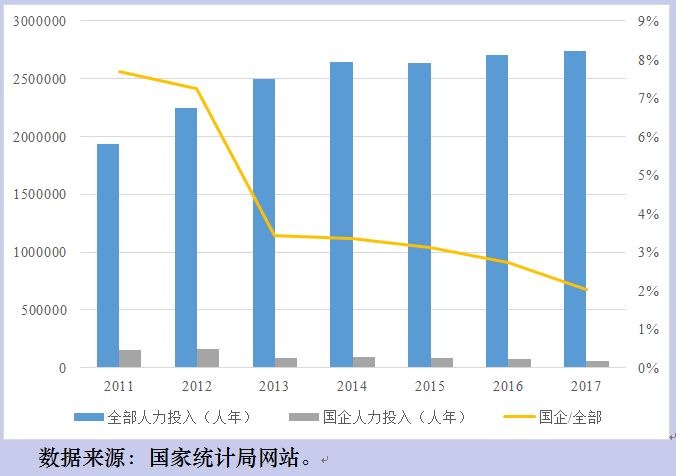
Enterprises, as organizations facing the market directly, ought to rely more on the intellectual-property system. But here state enterprises perform far worse than private ones. In 2016, though state-owned and state-controlled industrial enterprises held 45 percent of the original value of fixed assets of all above-scale industrial enterprises, their human resources and funds invested in R&D were only 7.4 percent and 2.6 percent of the total. More shocking still, against a backdrop of continually rising R&D investment by most Chinese enterprises, state enterprises' R&D investment fell sharply year by year. From 2011 to 2017, human input fell from 148,871 person-years to 55,692; R&D funds fell from 46.78 billion yuan to 21.34 billion. The likely reasons are, first, that state enterprises rely more on state research institutions for R&D, and second, that state enterprises have no motive to do R&D. That is, state enterprises do not rely on the intellectual-property system or the market. NBS data show that in 2016 the valid patents obtained by state enterprises were only 3 percent of the total—which is to say non-state enterprises are the main force using the intellectual-property system. In 2017 the turnover of our country's technology market was 1.3424 trillion yuan; the funds from the market far exceed those from the government, and by the above proportion, these funds mainly supported the R&D of non-state enterprises.
But this does not mean state enterprises are better suited to using government funds. In an article titled "Do Government Subsidies Promote the Improvement of Enterprise Patent Quality?" the author concluded that "government subsidies have a fairly significant promoting effect on the patent quality of private enterprises," but "fail to effectively raise the patent quality of state enterprises—on the contrary, they have a certain inhibiting effect." This is because "state enterprises have a natural connection with the government," and since "the government controls the pricing and allocation power over key factors such as land, capital, and labor, state enterprises are more inclined to choose to establish rent-seeking ties with the government to obtain excess profits or rent-seeking gains." The author also found that "in regions with more complete intellectual-property protection, government subsidies have a more significant effect in raising enterprise patent quality; conversely, in regions with less complete protection, government subsidies have an inhibiting effect" (Kang Zhiyong, Scientific Research, 2018, no. 1). This conclusion can also apply to different types of enterprise. Compared with private enterprises, state enterprises rely less on the intellectual-property system, and internally lack a mechanism to incentivize technological innovation; a great many inventions are treated as work-duty inventions and given very little reward.
This seems to differ from people's impression. Have not quite a few state enterprises created leading technology? State enterprises have one advantage: monopoly rights over the domestic market. When foreign enterprises want to enter the Chinese market, these monopoly state enterprises use the huge domestic market as a bargaining chip to force the foreigners to submit. The key is that, once they have obtained foreign technology at a low price, they proclaim it "indigenous innovation." A most typical example is high-speed-rail technology. China's internet is awash with texts saying "high-speed rail is our country's indigenous innovation," but an article titled "On the Promotion of Indigenous Innovation in Our High-Speed-Rail Technology by Government Procurement" says: "The railway authorities, representing the government, acted as the procurement entity; our country's huge market for railway equipment, and the railway authorities as the largest, most purchasing-powerful single consumer in the domestic market—these factors exerted on Western companies such as Siemens, Bombardier, and Alstom both an alluring attraction and strong competitive pressure," "ultimately bringing about the introduction of advanced high-speed-rail technology at a fairly low price" (Xu Renying and Pan Lei, Sea of Science Story Panorama: Science-Education Forum, 2011). Here "single consumer" introducing "advanced technology at a low price" seems to explain the matter.
One may hold that proclaiming an introduced technology to be our country's indigenous innovation is the relevant administrative departments or state enterprises claiming heaven's merit as their own where they lack the capacity to innovate. According to industry insiders, former railways minister Liu Zhijun proclaimed, before leaders and foreign experts (who understood no Chinese), that our high-speed-rail technology was indigenous innovation. But after Liu's downfall, controversy arose over his approach. Both sides—for and against—acknowledge that high-speed-rail technology was introduced from Germany, France, Japan, Canada, and other countries; the pro-Liu camp merely affirms his merit in introducing it, while the anti-Liu camp attacks him for suppressing domestic indigenous R&D for the sake of that introduction. The pro-Liu camp says that "to win more orders, the Japanese, French, Germans, and Canadians" competed to cut prices, "the prices ever lower." "Three years later, when the railway ministry tendered to buy genuine high-speed trains of 350 km/h, Siemens quoted a price even cheaper than the 250 km/h trains of three years before, and promised to sell the whole-vehicle manufacturing technology for 80 million euros"—and so Liu Zhijun could proclaim to the media that he "possessed indigenous intellectual property."
If the above discussion is correct, we can see that China's technological development over these decades has relied mainly on private enterprises pushing forward within the broad environment of the intellectual-property and market systems; whereas the technological innovation of the state sector that we imagine is more likely the result of "introducing foreign technology at a low price" plus "propagandizing it as indigenous innovation." They do this to preserve the traditional research system, which consumes more than 800 billion yuan of state fiscal resources a year to very poor real effect, but is the interest group's cake. Though the phenomenon has been recognized by the tech world and the government—who call the national research funds a "monk's flesh"—and there have been some minor reforms, this system still stands unshaken, perhaps precisely because of such false propaganda. But though this has deceived society and the public for quite a long time, it has also, unintentionally, given foreigners a strong impression: that China's technological development relies mainly on government subsidies and uses the Chinese market as bait to force foreign enterprises to transfer technology at low prices. Look—this is precisely one of the grounds for America's complaint of China's "unfair trade."
Yet the intellectual-property and government-subsidy issues raised by the Sino-American trade war let us think carefully about what exactly ails the government-led research system. In short, it is this: wanting only results, not the process; only the terminal product, not the machine tool that makes it; only short-term visible achievements, not the long-acting institutional foundation. Under this dominant idea, China—apart from achievements built on statistics and self-propaganda—can never reach the world frontier in science and technology; instead it draws the censure of other countries founded on misunderstanding. The solution is to turn this inverted priority right-side up again. This was originally the Chinese view. There is an old Chinese saying: "Better to teach a man to fish than to give him a fish." It can also be put the other way: "Better to learn fishing from a man than to be fed fish by him." The fish is only the result of fishing; intellectual property is only the result of the institutional structure that forms it. Broadly speaking, this "institutional structure" is the rule of law. Why? Because it provides all the institutional conditions for the production of knowledge and intellectual property—conditions such as personal freedom, freedom of expression, freedom of communication, security of property, judicial fairness, academic tolerance, openness of information, freedom of enterprise operation, and intellectual-property protection.
And the greatest feature of the rule of law as this "totality of institutional conditions" is that it is unrelated to any particular purpose—very naturally, it seems to have no direct link to technological innovation. Yet this is precisely its greatest merit. As Hayek said, the core of the rule of law is a set of "rules of just conduct," and one condition for these rules to work is that they aim at no concrete purpose, so they are abstract, universal, and possessed of general fairness, and only thus can they become the environment of an environment for technological innovation. He said: "The 'values' that the rules of just conduct serve are not the details of an existing actual order that people wish to advance, but the abstract features it possesses, because people find that it is precisely these abstract features that are the condition for effectively pursuing countless differing and unforeseeable purposes." It is precisely because of this feature—the efficacy of the rule-of-law character, its efficacy in most promoting human purposes on the whole and in the long run—that it is overlooked. To carry on technological competition by means that violate the principles of the rule of law is to try to win the small game at the cost of losing the big one. It is precisely their violation of the rule of law that makes it forever impossible for their technology to lead. If the wise of humankind have already told us of this connection and we remain too dull to grasp it, we can no longer blame our ancestors.
The English for fa is "law," meaning natural law—including the rules of the natural world and the rules of human society. Technological innovation must also follow natural law, or it will lack efficiency. In short, the basic resource of technological innovation is the human brain, and the most fundamental mode of technological innovation is to form an institutional structure that can maximally spark the flashes of wisdom in the human brain. And the human brain is the most unfathomable resource: from whose head, exactly, what marvelous idea will be sparked, we cannot know in advance. Yet this is precisely the true meaning of "innovation." To achieve it, this institutional structure must be most inclusive, allowing exploration in every direction; most fair, letting reward match contribution most accurately; most efficient, giving every brain of potential the chance to burst forth with inspiration. This is an academic system with no forbidden zones of discussion and with fair exchange, a market system that has innovators strive by usefulness, and an intellectual-property system that gives innovators fair reward. Under this institutional structure, people do not know who will be the next Newton or Einstein, Edison or Jobs; but people firmly believe that the innovators emerging under it will far surpass what those who plan by existing knowledge can imagine.
Yet as stated above, the problem of China's technological-innovation system is precisely that too many resources rely on government allocation and too few are allocated through academic rules, the market, and the intellectual-property system. This is not only a matter of too-low efficiency in resource allocation; it also corrupts the research community, making them weigh power and connections more and research itself less. There is a further problem: this system itself becomes the cake of those with the power to decide. They may know from the start that it is ineffective, but it brings them enormous benefit. And these are precisely the people who hold power; far from promoting reform of this system and reducing the share of resources allocated by power, they will keep expanding it. Absent constraint on power—and power itself is naturally expansionary—this distorted research system is very hard to reform, because the moment one moves to reduce the scale of national research funds, or to constrain the role of power in the tech-evaluation system, one meets the resistance of the relevant power departments. And the rule of law means, in its very essence, the limitation of power. Because "rule of law"—the rule of law—stands opposed to the rule of man ("rule by men"): all people, including the most powerful, must obey the law, and so the rule of law is the miracle cure for this chronic ailment.
To practice the rule of law, one should not treat it as a tool for realizing present purposes, but attend to its generality, the fairness guaranteed by due process of law, and its foreseeable long-term stability. By "generality" is meant that the full exercise of intellectual property depends on a complete system and comprehensive environment for protecting it—an institutional structure covering every level of society. This is because the individual citizen or enterprise is the subject of intellectual property; if a citizen's personal safety or an enterprise's property rights cannot be protected, the benefits of invention and innovation cannot be protected. When we see personal freedom or enterprise property rights unprotected, we may also infer that intellectual property is in fact unprotected. Even incidentally, this lack of protection for human and property rights can directly harm scientific research itself. For example, in the case of Chinese Academy of Engineering academician Li Ning, suspected of embezzling public funds—however the judiciary rules—the most important point is that the case dragged on unresolved, with Li held in custody from 2014 without lawful release on bail, making the defendant bear the cost of low judicial efficiency, an infringement of personal freedom. So when we see the Chinese government's response to the Meng Wanzhou case—the two Canadians it seized also not released on bail—we should recognize that this in fact harms China's technological innovation just as Li Ning's experience did.
Second, the aim of the rule of law is fair adjudication. Although the Coase theorem assumes that when transaction costs are zero, even a judge's arbitrary ruling leads to optimal resource allocation, Coase pointed out in his famous paper "The Problem of Social Cost" that in the real world of positive transaction costs, a judge's fair ruling has an important effect on resource allocation. Fair adjudication is thus also an important factor in ensuring the optimal allocation of research resources. And to ensure fair rulings, the most important thing is to guarantee that due process of law is followed. In China's reality, this due process often cannot be carried out. Court rulings, for instance, are often made in advance by the "political-legal committee," violating the principle that judges try cases independently and free of any interference (Constitution, Article 113); and the "televised confessions" so common in our country violate the principle that "no one may be compelled to incriminate himself" (Criminal Procedure Law, Article 50). Article 33 of our Criminal Procedure Law provides that a criminal suspect "has the right to entrust a defender" from the very start, but after the Chinese government detained the two Canadians, it long forbade them to see family or to hire lawyers. Recalling the experience of the outstanding scientist and tech entrepreneur Chu Jian—held for nine months, "stipulated to be allowed to see no one, including a lawyer"—we can see that this is merely part of the general phenomenon of violating due process; it is harm to Chinese, inflicted here on the head of foreigners, and it goes without saying that this includes the destruction of China's technological innovation and its environment.
Third, the rule of law must give people long-term stable expectations. Only when people believe the rules of law will remain valid in future will they take them as the standard for deciding present action. Some economic historians ascribe one cause of modern economic development to "roundabout production"—the lengthening of the production cycle, including the innovation cycle, which requires investment decisions of longer expectation. The significance of written law is to proclaim the basic rules to all in advance, giving people a rough expectation. In our country's courts, people cannot sue unconstitutional acts, and the Constitution cannot underpin everyone's long-term expectation of China's legal environment. Article 35 of the Constitution provides for freedom of expression, but in reality the founding and publishing of academic journals is strictly limited, and publishing a book still requires review and permission. Article 41 provides for freedom of communication, but the unconstitutional internet firewall blocks platforms like Google Scholar, and the academic journals I subscribe to from abroad have gone missing four issues in a row. So not only can the written Constitution fail to give people stable expectations; it directly harms the information environment of scientific research. The government often disregards the long-term stability of law for present purposes, replacing law with opaque policy and thereby doing things that destroy legal expectations. When we see problems of this kind pointed out in the US government's Section 301 Investigation Report, we will not find them unfamiliar for involving harm to American enterprises—Chinese enterprises, too, seem to have seen the like.
Viewing the Meng Wanzhou and Huawei case with this understanding, the correct approach should be to contend within the framework of the rule of law: to fight for the rights of Huawei and China, while respecting the principles of the rule of law. By "principles of the rule of law" is meant not only the principles of common law but also the present principles of Chinese law. In their textual expression the two have no great divergence; they differ only in implementation. On the broad principles, both have independent trial, the presumption of innocence, acquittal in case of doubt, and the bar on compelled self-incrimination; in procedure, both give the defendant the right to hire a defender, the right to release on bail, and so on. But the Chinese government's moves are basically actions outside due process of law, attempting to win a single round of the game through extralegal pressure; whereas the Canadian and American governments' moves are within due process of law, seeking a lasting victory tested by procedure. The results will be very different. To win a so-called "technology war" by means that violate the rule of law is in fact to destroy the basic environment for technological development, ultimately leading to defeat in the "technology war." So placing the effort for Huawei within due process of law will not only increase Huawei's odds of winning but improve the institutional environment of China's technological development. We see that Huawei has already taken actions within legal procedure—including alleging the "political motive" of the Meng Wanzhou case, and its countersuits against the Canadian and American governments—all worthy of affirmation.
When people say the problem Huawei faces is a Sino-American "technology war," they seem to weigh more heavily those terminal products of the intellectual-property system called "core technology," while gravely underrating the intellectual-property system itself and the rule of law that ensures its efficacy. Laozi said, "The great Way is utterly simple"; likewise, the great Way must be manifest. The paradox is that the terminal products of knowledge are often kept secret, myriad in kind, and require payment; whereas the most important institutional condition—the rule of law—is plain for all under heaven to see, utterly simple in its rules, and can even be given away free. But the fact in our country is that readers on the rule of law, unprotected by patents, pile up to the rafters, yet no one wants to put them into practice; while it is the terminal knowledge products with intellectual-property protection that people flock to. In truth, if one wants core technology, the effort lies "outside the poem." Though China has built an intellectual-property system, with great progress, in 2017 core patents were only 1.6 percent of total grants, equivalent to 9.76 percent of America's core patents (China Merchants Securities, "An All-Round Comparison of Sino-American Patents: China's Patents in Catch-Up," July 23, 2018). The gap should lie mostly in the rule-of-law environment. Some may say that in the initial stage of China's technological development, the best strategy is still to take ready-made technology. Even so, China has now reached a turning point—whether to keep picking fruit from others' trees, or to plant its own. As it happens, the foolish Americans are again forcing the Chinese to plant trees. Let us turn their scheme to our own advantage.
Reprinted from "Unirule Viewpoint."